
Read Meade County Deed Types
The Meade County Clerk records deeds along with mortgages, easements, plats, restrictions, releases, liens, wills, and affidavits. The deed's form signals how a transfer happened. Only the instrument's own terms reveal what interest actually passed.
| Deed Type | What It Does | Common Use |
|---|---|---|
| Warranty deed | Conveys the stated interest with covenants | Ordinary arm's-length transfer |
| Quitclaim deed | Conveys whatever interest the grantor has | Family or title cleanup |
| Correction deed | Corrects an identified earlier instrument | Name or description correction |
| Executor or fiduciary deed | Transfers through authorized fiduciary action | Estate administration |
| Sheriff or commissioner deed | Records a judicial or statutory transfer | Foreclosure, partition, or sale |
A deed conveys an interest. A mortgage, judgment, tax lien, restriction, or easement can burden that interest without changing the owner of record. So search assignments, modifications, releases, and partial releases alongside the deed chain itself.
Meade Deed Coverage Has Milestones
The Clerk's land-record page lays out several stages. There is index-only real-estate coverage from 1993. CCLIX indexing and imaging began in August 1995. More than 300,000 images are now accessible. The broader legal-record page notes that most online instrument images begin in January 2004. Those are separate milestones, not one blanket cutoff.
An index-only result is a locator, not the deed text. Request the image by instrument number or book and page. The free courthouse index stands in for paid eCCLIX access when needed.
The county's own coverage explanation spells out each stage.
Keep each year attached to what it covers. Index availability and image availability are different things in Meade County.
eCCLIX Uses Names, Not Tax Lots
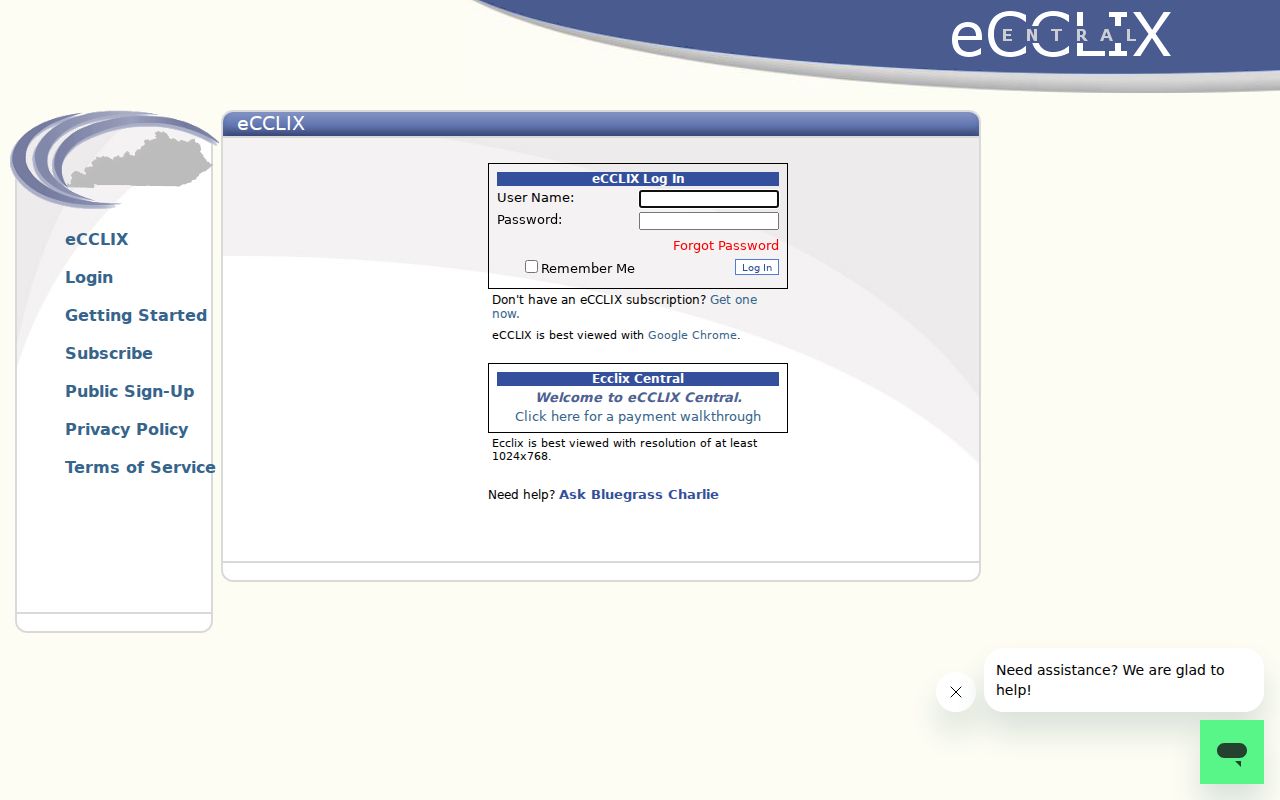
eCCLIX cannot search directly by tax lot or parcel number, according to the vendor. Start instead with the PVA map number and owner display. Then carry that name into eCCLIX. The public Meade search screen sits behind an account login. Its current search fields may differ.
| User Name | Account login field observed |
|---|---|
| Password | Account credential field observed |
| Remember Me | Optional login control |
| Document search | Possible grantor, grantee, party, book/type/page, instrument, and date fields vary by county |
The captured eCCLIX login confirms the access barrier, not the unseen deed-result behavior.
Plan for a courthouse or written-request fallback before beginning a long chain.
Walk Meade Grantor-Grantee Records
Start with the latest recorded grantee or the owner shown by PVA. Copy every prior deed reference you meet. Search both sides of each transfer, because an estate, an entity, an indexing variant, or a judicial deed can break a one-sided search.
- Find the current acquisition with the owner as grantee.
- Read the grantor, legal description, and prior book/page from the full deed.
- Search that grantor as a grantee to find the earlier acquisition.
- Repeat, testing heirs, fiduciaries, sheriff, commissioner, and name variants.
- Move to deed books or microfilm when the result becomes index-only.
- Grantor
- The party conveying an interest.
- Grantee
- The party receiving an interest.
- Chain of title
- The linked sequence of transfers affecting the land.
- Book/page or instrument
- A locator for retrieving the recorded document.
Read Every Meade Deed Pointer
Pull every pointer from the deed. Check execution and recording dates, parties, consideration if stated, acreage, map, lot, block, exceptions, easements, restrictions, prior recording, and later corrections or releases. Kentucky deeds typically cite an earlier recording. Since 1890, that backward pointer has been the fastest historical key.
Consideration recited in a deed may not reflect the full economics. A quitclaim, affidavit of descent, fiduciary deed, or commissioner deed each plays a different role. None matches a warranty deed. Compare full descriptions rather than ranking documents by title alone.
Historic Meade Deeds Reach Microfilm
KDLA's inventory catalogs Meade deed microfilm from 1824 through 2009. It also lists wills from 1824 through 2010, plats from 1970 through 2009, land warrants from 1846 through 1852, and many tax-book runs. These sources bridge the chain whenever an online image stops.
The 1974 courthouse disaster calls for an inventory request, not an assumption of loss. Later pointers, microfilm, tax lists, wills, probate, and court orders can recover the path.
Note: Historic tax lists are generally arranged by district. They follow the landowner rather than a modern parcel number.
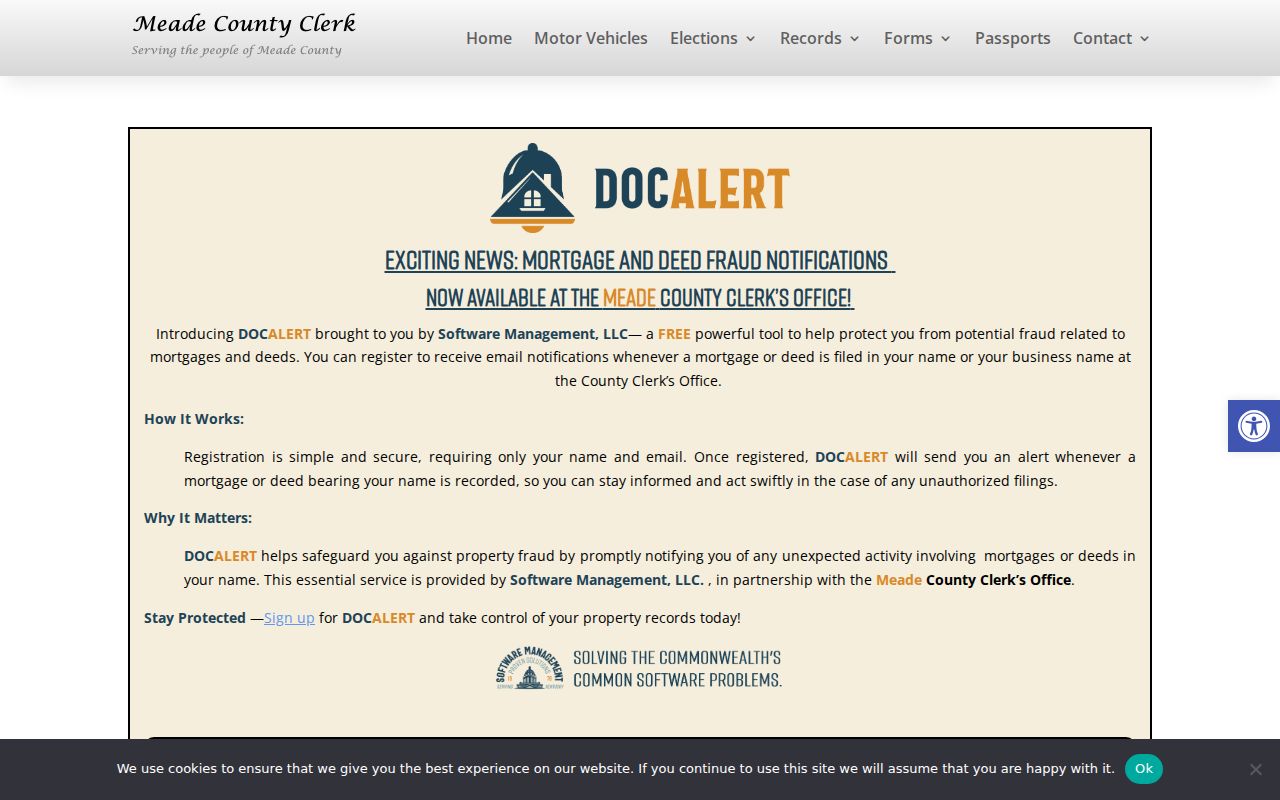
Meade Doc Alert Watches Filings
Meade Doc Alert sends free name-and-email notice. It fires whenever a deed or mortgage is filed under a registered person or business name. It works for early detection. It does not stop a filing, prove fraud, or replace review of the instrument itself.
Register every relevant name variant. Then compare any alert against the legal description and the Clerk's image. A similar name may belong to another parcel or party entirely.
Order a Meade County Deed Copy
Pull an online image when one exists. Use the free Clerk counter for public indexes and documents. You can also send a narrow request by hand, mail, fax, or email. Include the instrument number or book and page. Add the document type, parties, recording date, and desired format. The Clerk allows five working days for a written determination. That determination is not a guarantee of an old image.
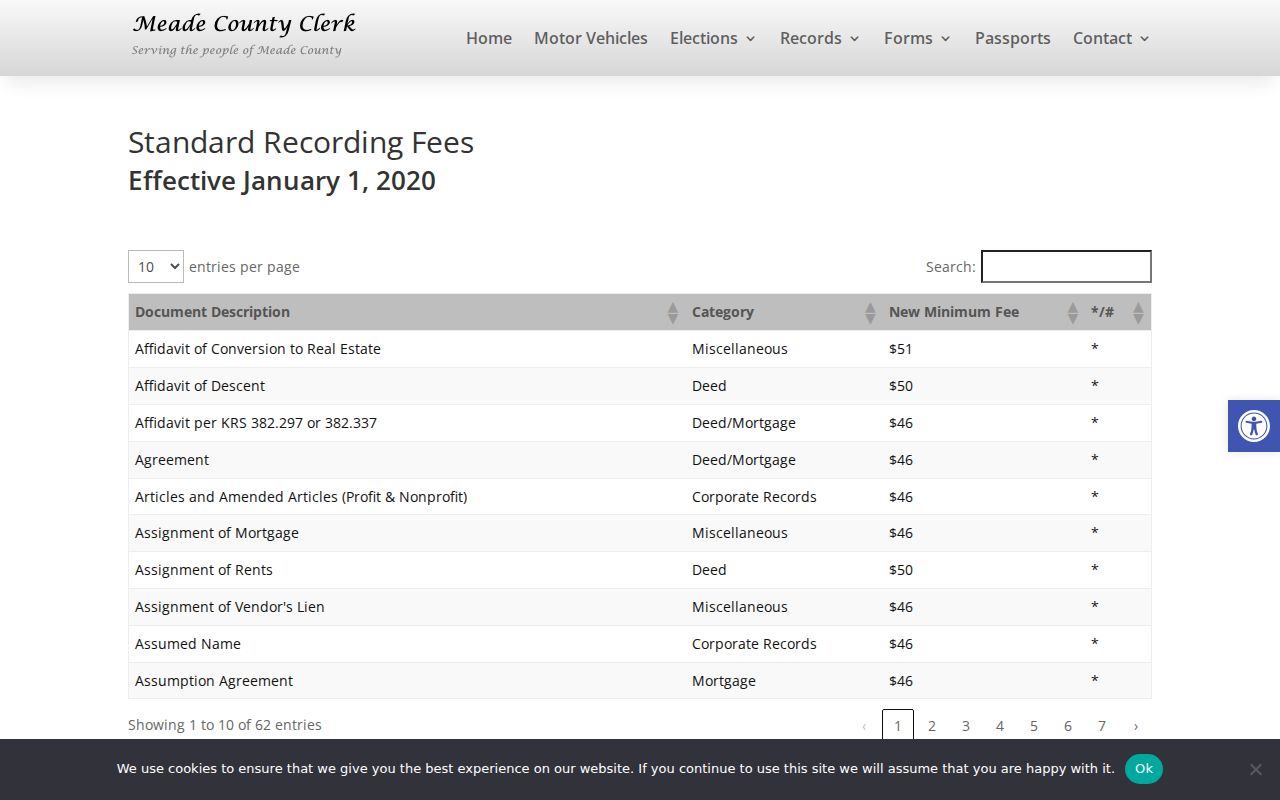
The published 2020 recording schedule lists $50 for a deed. A correction deed costs $46, a mortgage runs $80, and an easement or plat is $50. Page additions cost extra. These are recording charges, not universal search or copy prices, so reconfirm before ordering.
The fee schedule also helps identify instrument categories and dated charges.
Separate vendor access, statutory recording, plain-copy, and certified-copy costs when budgeting.
Recorded, not guaranteed. The Meade County deed index shows filed instruments, not a legal conclusion about title. Unrecorded interests, missing releases, probate, and court matters may require further review.
Match Meade Deeds to Plats
Plat research and deed research belong together. Preserve the subdivision name exactly. Include the plat book and page, lot number, road dedication, common areas, drainage, restrictions, and the linked deed. For rural land, add access easements, boundary agreements, road and stream calls, and partial releases. A preliminary planning application is no substitute for a final recorded plat.
A narrow copy request should name the indexed party, role, and date range. Add the instrument or book-and-page locator, map number if known, and format. If the image cannot be supplied, ask which book, microfilm series, or repository holds it. The office locates existing records. It does not decide ownership or legal effect.
Audit Meade Deed Chain Gaps
A single missing transfer rarely ends the hunt. Wills can fill the gap. So can settlements, affidavits of descent, probate cases, and partition suits. Lis pendens filings and sheriff or commissioner deeds work too. Kentucky's historical index guidance points researchers to H for heirs, C for commissioner, and S for sheriff. That applies where those lettering conventions hold. Before 1890, the tax roll can sometimes bridge an owner sequence that no deed pointer covers.
Give every link a clear status. Label it recorded image read, index-only, PVA display, secondary lead, or unresolved. A missing mortgage release is simply a follow-up item, not proof a debt still stands. The reverse holds too: a release never proves every claim has cleared. That careful wording keeps a Meade County deed record honest without overselling it.
Verify Meade County Deed Descriptions
Two deeds sharing a surname and similar acreage may still involve different land. Compare subdivision, lot, block, metes-and-bounds calls, PVA map number, adjoining owners, roads, streams, spouse names, exceptions, and recorded easements before matching anything. If a parcel was divided or combined, find the controlling deed or plat. Then track each resulting tract separately.
Look in both directions along the chain. A correction deed may fix one name or a single call. A partial release may touch only part of a mortgage description. A boundary agreement or road dedication can matter even when the grantee never changes. Cite the full image read, not an index row or PVA owner display, whenever you draw a conclusion.
County subdivision applications supply strong matching terms. The major-plan form asks for the subdivision name, PVA map number, deed book and page, acreage, lot count, access, water, sewer, and drainage. A deed record sharing those identifiers can tie a planning file to a later plat. A preliminary form still proves nothing about approval or recording. Pull the final decision and the Clerk plat reference.
Older rural descriptions lean on roads, streams, adjoining landowners, courses, distances, reservations, and exceptions rather than a street address. Transcribe those calls exactly as written. When a later survey, boundary agreement, or correction changes one part, do not assume the rest of the chain moved with it. Compare Meade County deed records tract by tract and instrument by instrument.
Connect Meade Deeds to Court Files
A clean buyer-to-seller chain snaps. Land moves through an estate, foreclosure, partition, quiet-title suit, or tax process. Search Kentucky's judicial archival indexes by plaintiff, defendant, and either-party, and try alternate spellings. Coverage is not comprehensive. Treat the index as a locator for the Circuit or District court file. Never treat it as a substitute for the file or the later recorded instrument.
Estates demand side-by-side comparison. Match the will, settlement, probate appointments, and affidavit of descent. Compare the fiduciary deed and later grantee against one another. For a judicial sale, connect the complaint, order, commissioner or sheriff action, and lis pendens. Tie them to the deed through case number, parties, dates, and legal description. A certificate of delinquency or sale notice marks one stage of a tax process. It does not establish a completed transfer by itself.
Keep every source in its lane. The court file explains authority and disputed interests. The County Clerk's recorded deed shows the conveyance actually filed. The PVA supplies the assessment name and map number. That data may update on a different clock. Read all three together. That keeps a court event, deed date, and tax-year display from collapsing into one false timeline.